
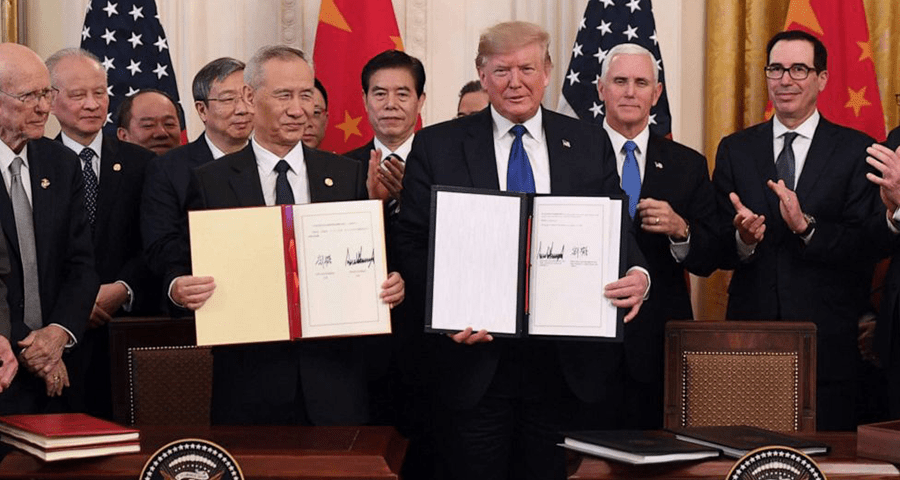
President Donald Trump and China’s Vice Premier Liu He officially signed a trade deal on Wednesday that offers both sides the ability to withdraw if a dispute cannot be resolved through high-level talks, according to Politico.
“Today we take a momentous step, one that has never been taken before with China, toward a future of fair and reciprocal trade,” President Trump said during a speech at the White House. “Together we are righting the wrongs of the past, and delivering a future of economic justice and security for American workers, farmers, and families.”
President Trump then thanked China’s President Xi, acknowledging that while the two represent different countries, the two have developed “an incredible relationship.”
“I want to thank [President Xi] for his cooperation, and partnership throughout this very complex process.”
“Our negotiations were tough, honest, open, and respectful,” Trump continued. “Leading us to this incredible breakthrough. Most people thought this could never happen. It should have happened 25 years ago by the way, but that’s okay.”
Politico reports that “consumers and businesses will still pay costly tariffs,” adding:
The United States will maintain 25 percent duties on roughly $250 billion worth of Chinese goods used mainly by manufacturers to make finished products in the United States. It will also keep a 7.5 percent tariff on another $120 billion worth of mostly consumer goods like jackets, gloves, footwear and flat panel electronic displays — although those were rolled back from 15 percent.
China will also keep retaliatory duties of 5 percent to 25 percent it slapped on roughly $110 billion worth of U.S. products it imports from the U.S. — a move that’s harming American exporters. But China will issue tariff “exclusions” for specific goods it has agreed to purchase as part of the deal, U.S. Trade Representative Robert Lighthizer told reporters.
The deal also requires China to buy a lot more U.S. goods, and fast. Politico writes that over the next two years, China will have to buy at least $200 billion more in U.S. products than it did in 2017.
Under the deal, China is expected to buy a minimum of $77.7 billion more of manufactured goods, $37.9 billion more of services, $32 billion more of agriculture and $52.4 billion more of energy over the next two years.
China has also pledged to try to buy at least $5 billion worth of additional farm goods in both 2020 and 2021, Lighthizer told reporters. In addition, sales of some other items, like lumber products, are expected to push the two-year agricultural buys to at least $80 billion.
China is reported to have also removed more than 50 government measures restricting the import on U.S. farm goods, including beef, pork, poultry, seafood, dairy, rice, potatoes and pet food.
China also promised to improve protection and enforcement of intellectual property rights.
U.S. Trade Representative Robert Lighthizer told reporters that the deal “gives procedures, it gives penalties, it sets standards.” Adding, “it’s not the gold standard, but it’s close to the gold standard of what you need in the intellectual property area.”
The 86-page document also includes an escape clause for both parties in the event private companies or government agencies aren’t upholding their country’s side of the deal. If the issue can’t be settled at the local government level, either country is permitted to walk away.
Politico notes that the United States and China won’t be able to retaliate against such action as long as they believe the other side acted “in good faith.” But if disputes become very serious, either side can provide written notice to withdraw from the deal, the pact says.
 Conservative Daily Update